
On this page
Key takeaways
- Start with the easy things. Thermostat settings, a tripped breaker and a clogged air filter cause a surprising share of warm-house calls.
- Ice on the copper lines or the indoor coil means turn cooling off and let it thaw. Running a frozen system can damage the compressor.
- Water in the pan under the indoor unit can shut your AC off on purpose to protect your ceiling.
- Never open electrical panels on the equipment or add refrigerant yourself. Those are jobs for a technician.
First, a quick look at how your AC works
Most homes in Acadiana have a split system: an outdoor unit, and an indoor unit in the attic or a closet, connected by two copper lines. Your air conditioner doesn’t make cold. It moves heat. Refrigerant picks up heat from your home’s air at the indoor coil, carries it outside, and the outdoor unit releases it.
Because every part depends on the others, a warm house can start with something as small as a dirty filter or a tripped breaker. That’s why the checks below go in order, from easiest to hardest.
Thermostat
Tells the system when to run. It needs power, the COOL setting and a temperature below the room’s.
Return grille and filter
Pulls house air back to the system. The filter catches dust before it reaches the coil.
Indoor unit and coil
A blower moves air across a cold coil. Heat and moisture leave the air here.
Condensate drain
Carries away the water the coil pulls out of the air.
Refrigerant lines
Two copper lines carry refrigerant between the indoor and outdoor units.
Outdoor unit
The compressor and fan release your home’s heat outside.
Supply vents
Deliver cooled air to each room.
Before you start: stay safe
- Don’t remove panels from the indoor or outdoor unit. Both have high-voltage parts inside, and some parts can hold a charge even with the power off.
- Never add refrigerant yourself. Low refrigerant means there’s a leak, and handling home AC refrigerant requires EPA certification.
- If you smell burning, see smoke, or hear loud grinding or screeching, turn the system off at the thermostat and call.
Find the likely cause in a few taps
Interactive tool
AC troubleshooter
Answer one question at a time. We’ll point you to a fix you can safely try, or tell you when it’s time to call.
Question 1
Is the thermostat set to COOL, with the temperature at least 3 degrees below the room temperature?
Check the screen too. A blank screen usually means dead batteries or no power to the thermostat.
The five-minute checks, explained
Check the thermostat
Mode on COOL, fan on AUTO, and the temperature set a few degrees below the room. Replace the batteries if the screen is blank. A smart thermostat may also lose its schedule after a power outage.
Check the breakers
Look for a tripped breaker labeled AC, condenser, air handler or furnace. Reset it once. If it trips again, leave it off and call.
Check the outdoor shutoff
Most outdoor units have a shutoff box on the wall nearby. Make sure its switch is on, or that the pull-out block is pushed fully in.
Change the air filter
A clogged filter is one of the most common causes of weak airflow. Write the date on the new filter’s frame.
Clear the outdoor unit
Remove leaves and grass clippings, and trim plants back at least 2 feet so the unit can breathe.
Open the vents
Make sure supply vents are open and the return grille isn’t blocked by furniture or curtains.
Look at the drain pan
Water in the pan under the indoor unit, or a tripped float switch, can shut the system off.
Why an air conditioner freezes in July
It sounds backward, but ice on a running AC is common in summer. The indoor coil normally runs cold, around 40°F. If too little air moves across it, or the system is low on refrigerant, the coil drops below freezing and moisture from the air freezes on it. The ice blocks even more air, and the problem snowballs.
- A dirty air filter
- Closed or blocked vents and return grilles
- A failing blower motor
- Low refrigerant from a leak
- A dirty indoor coil
Know what you’re looking at
This is a real attic installation. Select a number to see what each part does. Knowing the names makes it easier to describe what you’re seeing when you call.
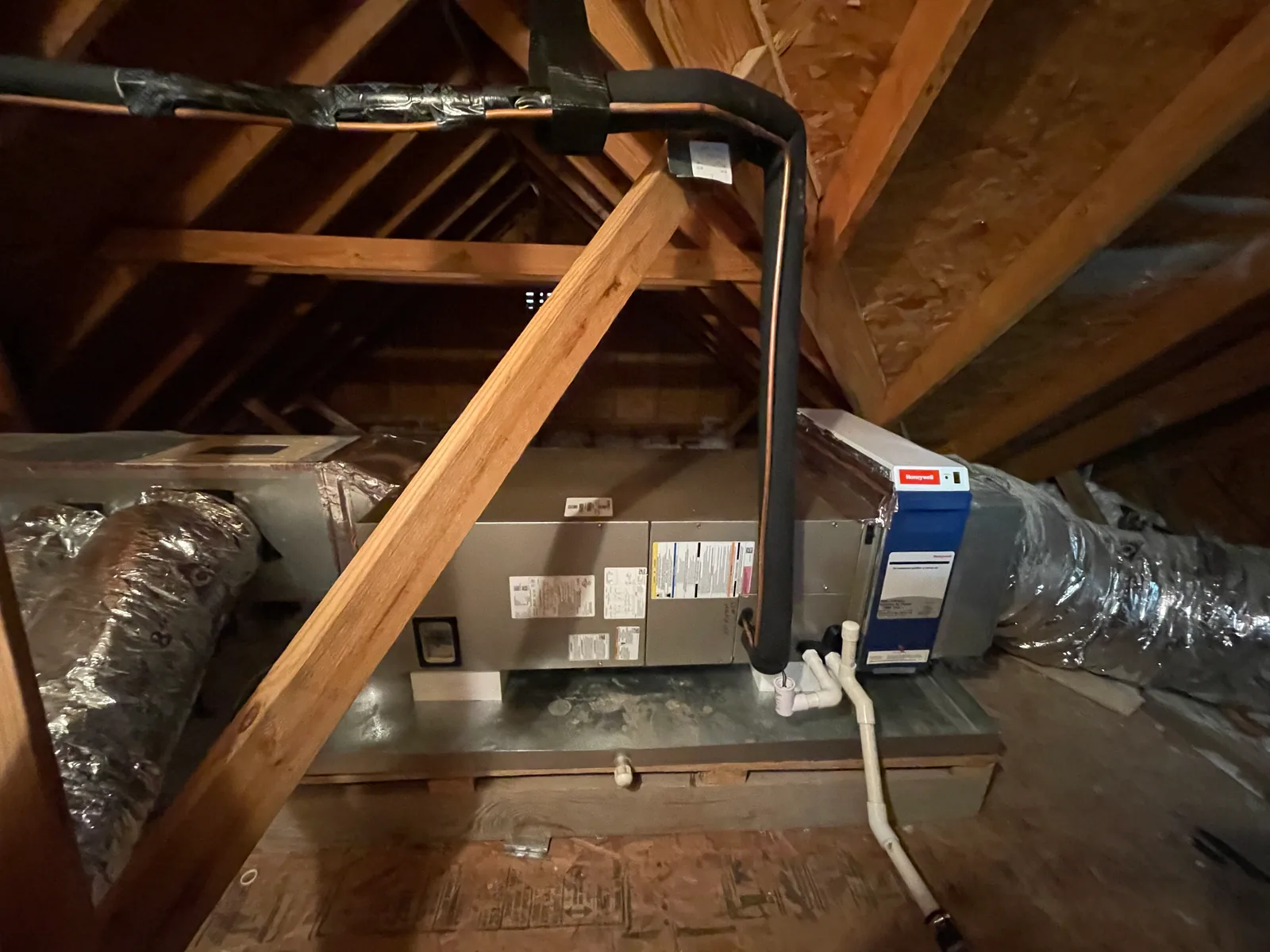
1 / 6
Refrigerant lines
Two copper lines connect this indoor coil to the outdoor unit. The larger, insulated line carries cool refrigerant back outside, and the thin line brings liquid refrigerant in. Torn insulation can sweat and drip in the attic.
On a visit: Every maintenance visit includes a refrigerant charge check. We also look for oily spots that can signal a leak.
Parts shown
When to stop and call
Safe for you to try
- Thermostat settings and batteries
- Resetting a tripped breaker once
- Replacing the air filter
- Clearing debris around the outdoor unit
- Letting a frozen system thaw
Leave it to a technician
- A breaker that trips again
- Humming, buzzing or a fan that won’t spin
- Ice that comes back after thawing
- Refrigerant, electrical parts and anything behind a panel
- Burning smells or smoke
Common questions
Sources
We checked the facts in this guide against these public sources.
- U.S. Department of Energy — Maintaining your air conditioner
- ENERGY STAR — Heating and cooling maintenance checklist
- EPA — Section 608 technician certification
This guide is general information for homeowners, not a diagnosis of your system. If you smell gas or a carbon monoxide alarm sounds, leave the house and call 911 or your gas utility first.